MyRadAssistant or ChatGPT for radiology?
ChatGPT is a brilliant general assistant. MyRadAssistant does one job: radiology answers traced to licensed, current evidence, for the whole imaging team.
£9.99 a month after your 14 day trial. No card needed. Cancel anytime.At a glance
Same question. Two answers.
We asked both the same question. Both answers are shown word for word. One example, not a benchmark.
For an incidentally detected solitary solid pulmonary nodule measuring exactly 8 mm, the 2017 Fleischner Society places it in the 6–8 mm category rather than the ">8 mm" category. RSNA Publications +1
If the nodule is larger than 8 mm, management changes to considering CT at ~3 months, PET/CT, tissue sampling, or a combination, guided by morphology and clinical risk. RSNA Publications
A useful exam distinction is therefore:
8 mm → 6–8 mm pathway
9 mm (or >8 mm) → >8 mm pathway
These recommendations apply to incidentally detected nodules in adults, and not to lung cancer screening, immunocompromised patients, or patients with a known primary malignancy. RSNA Publications
- An 8 mm solid nodule falls in the Fleischner 2017 6–8 mm category, not the >8 mm category. For low-risk patients: CT at 6-12 months, then consider CT at 18-24 months; for high-risk patients: CT at 6-12 months, then CT at 18-24 months 1.
- In UK practice, BTS guidance, which iRefer follows, treats 8 mm as the threshold for Brock risk assessment. This is a material difference from Fleischner.
- Check the patient is eligible before applying Fleischner. The guideline does not apply to lung cancer screening, patients younger than 35 years, or patients with a history of primary cancer or immunosuppression. 2
- Both placed the 8 mm nodule in the right Fleischner category.
- Only MyRadAssistant flagged that UK BTS guidance uses 8 mm as the threshold for Brock risk assessment.
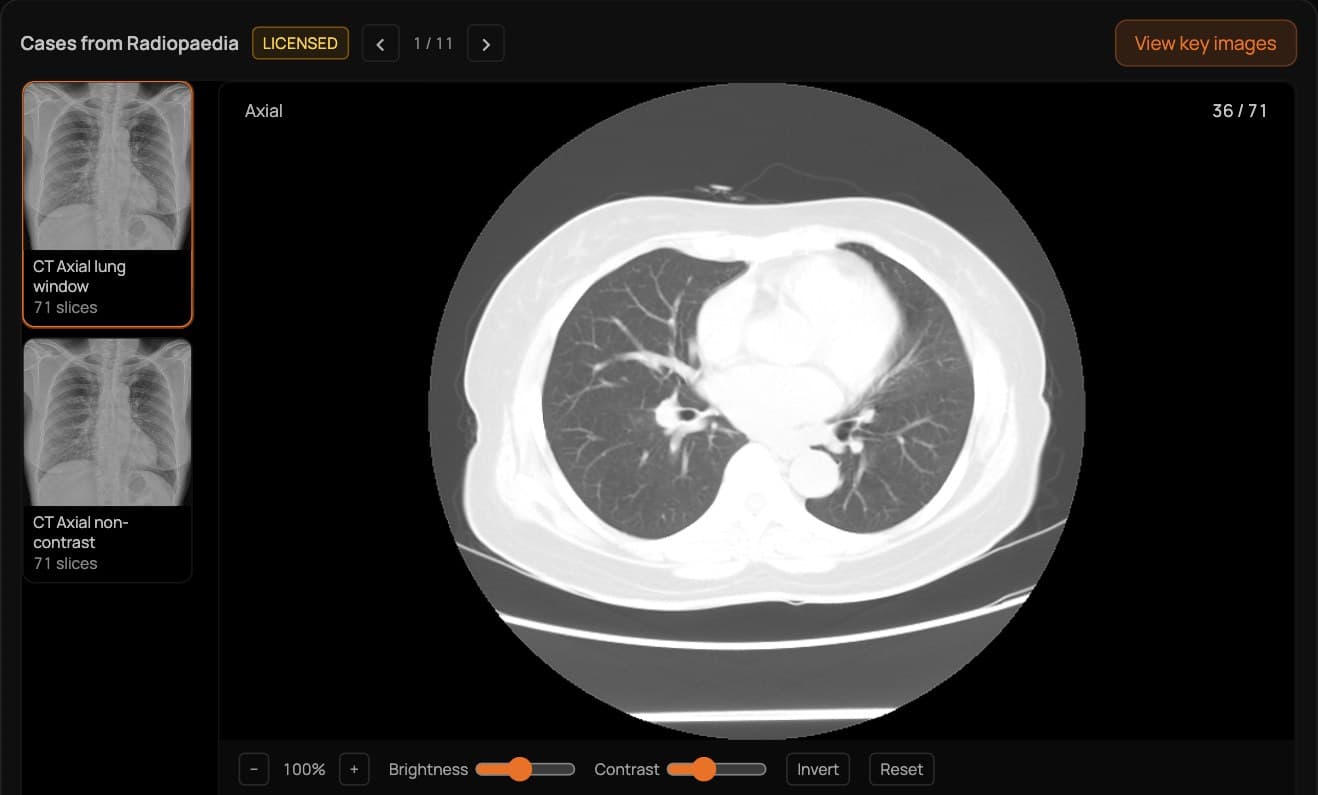
- Only MyRadAssistant returned real licensed cases you can scroll through.
Both answers are each the first run, shown word for word; MyRadAssistant's is shortened to its key points and its case viewer. ChatGPT was used on a Pro plan with default settings in a temporary chat, and its answers can vary between runs. ChatGPT is a trademark of OpenAI. MyRadAssistant is not affiliated with or endorsed by OpenAI.
Use the right tool for the job.
- Checking what the guideline actually says, and which version is current
- Revising for FRCR with answers you can trace to source
- Seeing real licensed cases of the condition you are reading about
- Getting structured feedback on a practice report
- Drafting emails, rotas, audit write ups and teaching slides
- Questions outside radiology
- Brainstorming, summarising and editing your own writing
- Code, spreadsheets and everyday admin
What about ChatGPT for Clinicians?
OpenAI launched ChatGPT for Clinicians in April 2026. It is free for verified clinicians in the United States and needs a US National Provider Identifier, so it is not yet available in the UK. OpenAI says it plans to add more countries.
Questions
- Can I use ChatGPT for radiology questions?
- For general learning, yes, with care. It isn't built on licensed radiology content, it doesn't grade evidence, and on Free and Plus it trains on your conversations unless you switch that off. Check anything important against the primary source.
- Is MyRadAssistant just a wrapper around ChatGPT?
- No. It runs its own retrieval, evidence ranking and checks over licensed radiology content before an answer is written, and every claim links back to its source.
- Is MyRadAssistant a clinical decision tool?
- No. It is a literature reference and educational aid. It is not for use at the point of care on an individual patient.
- Can I try it before paying?
- Yes. You get 14 days free with no card needed, then £9.99 a month. Cancel anytime.
Keep ChatGPT for writing. Use us for the evidence.
£9.99 a month after your 14 day trial. No card needed.
ChatGPT is a trademark of OpenAI. MyRadAssistant is not affiliated with or endorsed by OpenAI. ChatGPT details come from OpenAI's published help pages and may have changed since.